Dear Yamaha: Build the Fingerstyle Guitar We Keep Waiting For
Yamaha already builds every piece of the perfect steel-string fingerstyle guitar. They just haven't put all of those pieces in the same case yet.
If you play fingerstyle on steel strings, you know the hunt. You want room between the strings for your fingers to actually land where you aim them, a body that answers a light touch instead of needing to be beaten into speaking, and a cutaway so the upper frets aren't a reach-around. Then you go shopping and find out that most of the market was built for the guy with a pick and a capo on the second fret. I ended up buying a Yamaha concert cutaway mostly because it was the only one in their catalog with a full 1-3/4" nut. That's not how anybody should pick a guitar, and it's a pretty good sign there's a hole in the lineup.
The gap in the lineup
Yamaha makes two Japanese-built concert guitars with a full 1-3/4" nut, an ebony board, bone at both ends and Atmosfeel electronics, and neither one has a cutaway. The concert models that do have a cutaway drop to a 1-11/16" nut. Put them side by side and the hole is pretty easy to see.
Model | Body | Cutaway | Nut width | Top | Back & sides | Electronics | Nut & saddle |
Concert | No | 1-3/4" (44 mm) | Solid Adirondack spruce | Solid African mahogany | Atmosfeel | Bone | |
Concert | No | 1-3/4" (44 mm) | Solid Sitka spruce (A.R.E.) | Solid mahogany | Atmosfeel | Bone | |
Concert | Yes | 1-11/16" (43 mm) | Solid Sitka spruce (A.R.E.) | Solid mahogany | SRT2 | Tusq | |
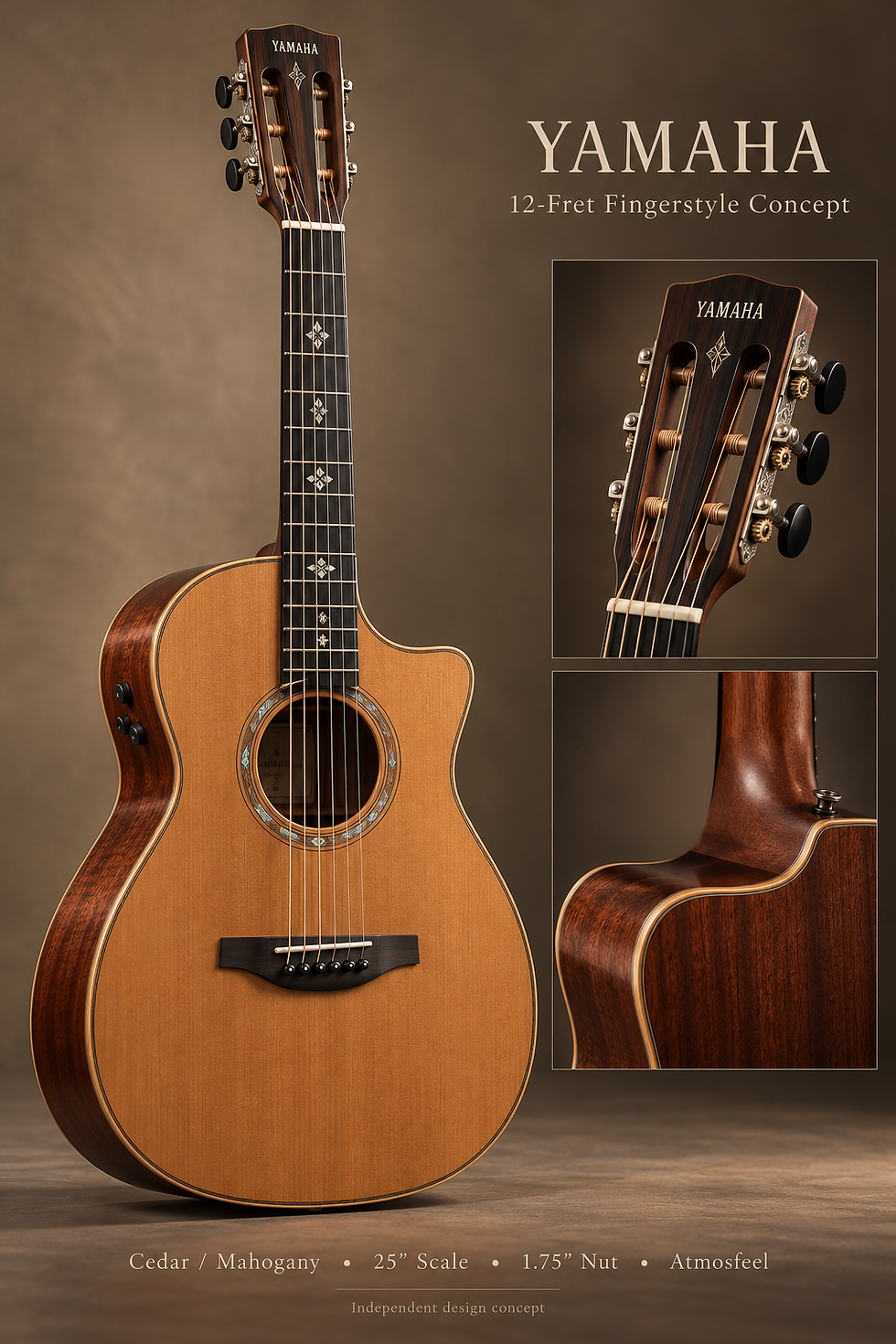
The one I'm asking for | Concert, 12-fret | Soft | 1-3/4" or a hair wider | Solid cedar | Solid mahogany | Atmosfeel | Bone |
Don't get me wrong, the FS9 is a gorgeous instrument, and Yamaha's own copy says the concert body particularly shines when it's fingerpicked. They know who that body is for. They built the fingerstyle guitar, priced the acoustic-only FS9 M around $3,999 street, and then left off the one feature that lets a fingerstyle player actually use the top of the neck. As far as I can find, there isn't a single 12-fret steel-string anywhere in the current catalog either.
Here's what makes it sting a little. Yamaha has spent real engineering money on the player who sits between two worlds, it just points the other direction. The NTX nylon-string line is built specifically for electric and steel-string players crossing over, with a slimmer neck than a classical and Atmosfeel in the top models. That's a thoughtful guitar. But if you're a fingerstyle player who wants the snap, the shimmer and the sustain of steel, Yamaha's answer is basically "have you considered nylon?" A lot of us have. We still want steel.
Building it, spec by spec
None of this is exotic. Almost every item on the list is already sitting on a Yamaha workbench somewhere, and each one earns its spot by giving a light right hand more to work with.
The neck: wide nut, ebony board, 25" scale, 12 frets to the body
A 1-3/4" nut is the floor, and if Yamaha wanted to push it to 1-13/16" I wouldn't complain, especially for players who run an alternating thumb bass all night. The width has to carry all the way through, though. Spread the strings to something around 2-1/4" at the saddle so the picking hand gets the extra room too, because a wide nut with cramped bridge spacing only fixes half the problem. Ebony for the board is a given. It's hard, it's slick under the fingers, and it'll outlast the player.
The 25" scale is a touch slinkier than the 25-9/16" Yamaha uses on its dreadnoughts and the A-series, which makes vibrato and partial capos a little friendlier. Then the 12-fret body joint does the heavy lifting. Joining the neck at the 12th fret moves the bridge down toward the middle of the lower bout, where the top has the most room to move, and that's a big part of why 12-fret guitars tend to sound bigger and warmer than a 14-fret with the same footprint. It also brings the first position a little closer to your body, which your shoulder will thank you for around the third set.
Somebody's going to say a cutaway on a 12-fret defeats the purpose. It doesn't. On a 12-fret the body starts where a 14-fret neck is still giving you room, so the cutaway is exactly what buys those frets back without giving up the bridge placement.
The body: cedar over mahogany, with a soft cutaway
Cedar is the fingerstyle top. It opens up fast, it wakes up under a light touch, and it has a warm, complex voice at the volumes most of us actually play at. The trade-off is that it compresses and gets a little mushy when somebody digs in hard with a heavy pick, which is precisely why it belongs on this guitar and not on a strummer.
Under it, solid mahogany for the back and sides, and I mean honest-to-God mahogany, not sapele wearing a mahogany name tag. Mahogany is dry and woody with a focused midrange, and it keeps cedar's naturally rich overtones from turning into a cloud the way rosewood sometimes can. The cutaway should be soft and rounded, the Venetian style, which keeps the lines of the body graceful and gives up less of the box than a sharp Florentine horn.
Bridge, nut, saddle and that slotted headstock
Ebony bridge, bone nut and bone saddle. Yamaha already does this on its better guitars, so I'm not asking for anything new, just asking them not to cheap out on it here.
The slotted headstock is where I'll get some pushback, and that's fine. On a slot head the strings come over the nut and dive back down to the rollers at a steeper angle than on a solid headstock, seating them harder in the nut slots, and a lot of builders and players credit that with clearer open strings and longer sustain. People have argued about how much difference it makes for about as long as there's been an internet. What nobody argues about is that it's the traditional look of a 12-fret, and that the tuner buttons sit behind the head where they're easy to reach mid-song. Pair it with high-ratio slotted tuners, 18:1 or close to it, because fingerstyle players live in DADGAD and open D and retune more than anybody in the room.
Electronics: Atmosfeel, because it already works
This one's easy, since Yamaha already puts Atmosfeel in the Red Label FSX models and the FS9 MX. It blends three sources, an undersaddle piezo, a thin contact sensor under the top for the highs, and a small internal mic, and it runs them through three small knobs on the side instead of a big plastic preamp window. Yamaha's own notes even point out that fingerstyle players may want less mic in the blend. For anybody who plays percussively or leans on harmonics, that's the difference between sounding like your guitar and sounding like a piezo doing an impression of your guitar.
The finishing touches
Give it inlays in the spirit of the FS9's markers, which are modeled on traditional Japanese Kumiki woodworking. Keep the rope purfling and the understated look. A fingerstyle player spends a lot of time staring at that fretboard, and it ought to be something worth looking at that still says Yamaha without shouting it.
Why it should be Yamaha
Yamaha has been building steel-strings since the FG180 and FG150 in 1966, and its custom flattops have been in the hands of people like Paul Simon, Bert Jansch and John Denver. This isn't a company that needs to prove it can build a professional instrument. The FG9 and FS9 came out of a collaboration between Andrew Enns, Yamaha's senior acoustic builder in California, and the flagship shop in Japan, with acoustic measurement and 3D structural analysis behind the bracing and prototypes built by the custom shop's luthiers. That's the exact team you'd want on a guitar like this.
The bigger reason is what Yamaha does better than almost anybody, which is quality workmanship without the boutique tax. A 12-fret slot head with a cedar top and a cutaway is the kind of thing most players only see on a custom shop order form, with a price and a wait time to match. Yamaha already has the concert body, the mahogany, the ebony, the bone and the Atmosfeel in production. If it landed somewhere between the Red Label and the FS9, it would have that corner of the market more or less to itself.
And the players are out there. Fingerstyle has grown a whole generation of players who learned off YouTube and play solo instrumental steel-string the way earlier generations played in bands, and plenty of them are accomplished enough to know exactly what they want. Right now they're piecing it together from other brands or settling for close enough.
So here's the ask
Yamaha, you already built the fingerstyle body and you already built the pickup that makes it sound like itself plugged in. Put a cedar top on it, give it a soft cutaway and a 12-fret neck with a slotted head, and stop sending the steel-string fingerpickers over to the nylon aisle. Call it the FS9 C-12 or whatever the marketing folks come up with. I'd call it sold, and I don't think I'd be standing in that line by myself.
Now I want to hear from the rest of you. If Yamaha built this tomorrow, what would you change? Would you go wider than 1-3/4", swap the cedar for Adirondack, or keep the solid headstock and save yourself the string changes? Tell me in the comments, and if enough of us say it loud enough, maybe somebody in Hamamatsu reads it.


Comments